
Obey — Puppyplay
Jahr: 2024–2026
Werk: Videoinstallation / Mixed Media
Mitwirkende: Puppy Licky und Puppy Fyvel mit Herrchen
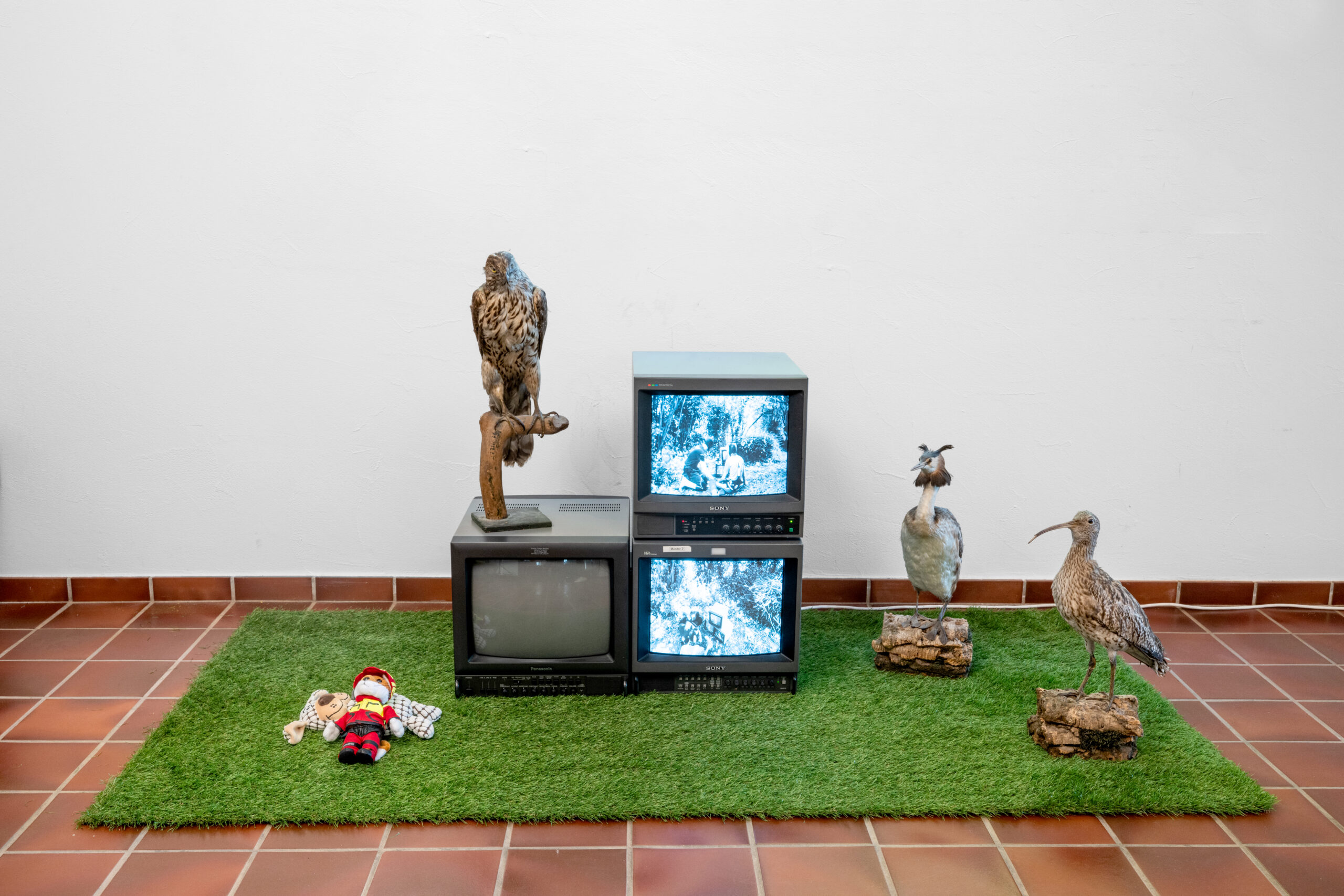
Wer die Installation betrachtet, wird unweigerlich Teil eines Dispositivs: Drei Monitore im Stil von Überwachungsanlagen werfen uns auf die Position der distanzierten Betrachtenden zurück. Auf den Bildschirmen sehen wir Körper im Spiel – vertieft in die Dynamiken des Puppyplay, einer queeren Praxis, die Intimität, Rollentausch, Hingabe und Fürsorge jenseits heteronormativer Konventionen zelebriert. Die Ästhetik der Überwachung entlarvt dabei sofort unseren eigenen Blick: Sind wir Zeuginnen und Zeugen, neugierige Voyeure oder die stummen Agenten einer bewertenden Kontrollgesellschaft?
Die Installation spannt einen dialektischen Bogen zwischen zwei gegensätzlichen Zuständen: dem erstarrten Konservieren und dem lebendigen Wandel. Die im Raum platzierten taxidermierten Vögel wirken lebendig, sind jedoch totes Material – präpariert, fixiert und in einer künstlichen Ewigkeit arretiert. Sie fungieren als Sinnbild für das gesellschaftliche Festhalten an überkommenen Moralvorstellungen und binären Dogmen. Diese «Taxidermie der Normen» verspricht Sicherheit, verwehrt jedoch jede organische Entwicklung. Sie repräsentiert den vergeblichen Versuch, eine Welt zu konservieren, deren Grundlagen längst erodiert sind.
In scharfem Kontrast dazu steht die Kultur des Puppyplay, deren Wurzeln tief in der queeren Emanzipationsgeschichte des 20. Jahrhunderts liegen. Nach dem Zweiten Weltkrieg sahen sich viele US-amerikanische Veteranen, die wegen ihrer Homosexualität unehrenhaft entlassen, kriminalisiert und pathologisiert wurden, an den Rand der Gesellschaft gedrängt. Aus dieser Erfahrung existenzieller Verdrängung formierte sich die Kink-Subkultur als radikaler Gegenentwurf: als Netzwerke solidarischer Resilienz und körperlicher Selbstbestimmung. Puppyplay entwickelte sich aus diesem Boden als eine Praxis, die den Zwang zur rigiden, hypermaskulinen oder leistungsorientierten Subjektwerdung abstreift. Das Einnehmen einer animalischen, verspielten Persona ermöglicht emotionale Entlastung, verletzliche Nähe und eine nonverbale Form des Vertrauens.
Heute, in einer Ära digitaler Hyper-Sichtbarkeit, stehen Subkulturen wie die Puppy-Community an einer neuen Schwelle: Das Internet ermöglicht weltweite Vernetzung und politische Mobilisierung, macht marginalisierte Körper aber zugleich verwundbar für voyeuristische Konsumierung und moralische Paniken. Sichtbarkeit schützt nicht automatisch vor Ausgrenzung – weder im gesamtgesellschaftlichen Kontext noch innerhalb queerer Diskurse selbst.
Die Installation stellt die Betrachtenden vor eine fundamentale Frage: Warum begegnen wir dem, was sich dem normativen Kanon entzieht, oft mit Abwehr oder Entfremdung statt mit Empathie? Die toten Vögel und die flimmernden Monitore fordern uns auf, den eigenen Blick zu dekonstruieren. Sie rufen uns ins Bewusstsein, dass jede künstlich aufrechterhaltene Norm irgendwann zerfällt. Wahre gesellschaftliche Toleranz beginnt in dem Moment, in dem wir die Angst vor dem Kontrollverlust ablegen – und dem Lebendigen Raum geben, sich frei von Überwachung und Stigmatisierung zu entfalten.
Anyone viewing the installation inevitably becomes part of a specific apparatus: three monitors, styled like surveillance systems, cast us back into the role of detached observers. On the screens, we see bodies at play—immersed in the dynamics of „puppy play,“ a queer practice that celebrates intimacy, role-swapping, devotion, and care beyond heteronormative conventions. The surveillance aesthetic immediately exposes the nature of our own gaze: Are we witnesses, curious voyeurs, or the silent agents of a judgmental society based on control?
The installation traces a dialectical arc between two opposing states: frozen preservation and living transformation. The taxidermied birds placed in the space appear lifelike yet consist of dead matter—prepared, fixed, and locked in an artificial eternity. They serve as a symbol of society’s clinging to outdated moral concepts and binary dogmas. This „taxidermy of norms“ promises security but precludes any organic evolution; it represents the futile attempt to preserve a world whose foundations have long since eroded.
Standing in stark contrast to this is the culture of puppy play, with roots reaching deep into the history of queer emancipation in the 20th century. Following World War II, many US veterans—dishonorably discharged, criminalized, and pathologized due to their homosexuality—found themselves pushed to the margins of society. Out of this experience of existential marginalization, the kink subculture emerged as a radical counter-model: a network of resilient solidarity and bodily self-determination. Puppy play emerged from this context as a practice that sheds the pressure to conform to rigid, hyper-masculine, or performance-oriented modes of subject formation. Adopting an animalistic, playful persona allows for emotional release, vulnerable intimacy, and a non-verbal form of trust.
Today, in an era of digital hyper-visibility, subcultures like the puppy community stand at a new threshold: the internet enables global networking and political mobilization, yet simultaneously renders marginalized bodies vulnerable to voyeuristic consumption and moral panics. Visibility does not automatically protect against exclusion—neither in the broader societal context nor within queer discourses themselves.
The installation confronts viewers with a fundamental question: Why do we often respond to that which eludes the normative canon with defensiveness or alienation rather than empathy? The dead birds and flickering monitors challenge us to deconstruct our own gaze. They remind us that any artificially maintained norm eventually collapses. True social tolerance begins the moment we shed the fear of losing control—and make space for the living to unfold, free from surveillance and stigmatization.